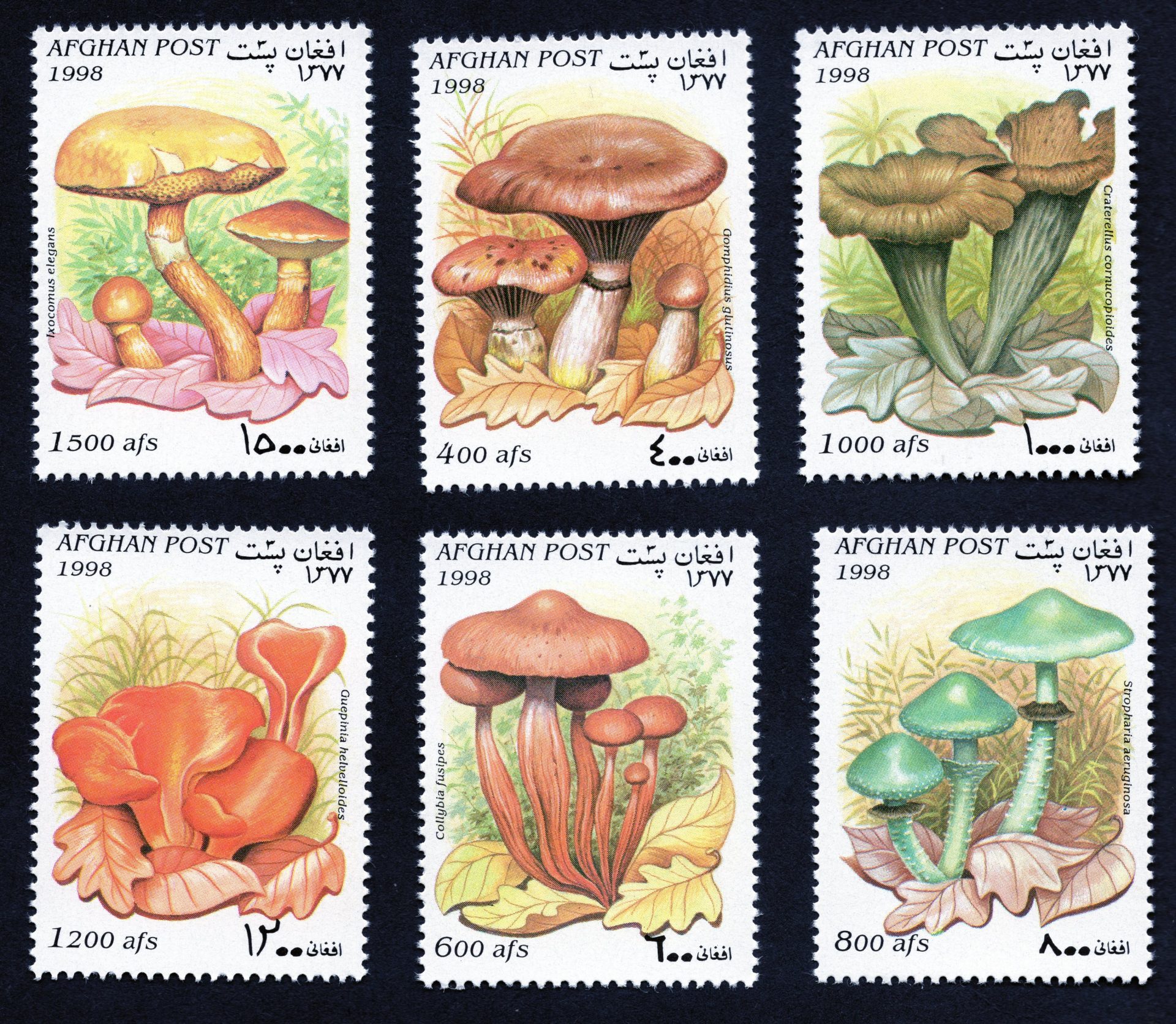
Mushrooms on Stamps: A 1998 Issue from Afghan Post
In 1998, Afghan Post released a beautifully illustrated set of postage stamps showcasing a selection of mushroom species from around the world. While many postal issues focus on national heritage, animals, or architecture, this release is a striking example of how even fungi, mushrooms and molds can become art when interpreted through a philatelic lens.
In 1928, Afghanistan became part of the Universal Postal Union.
Each stamp features a different species of mushroom, rendered in rich colour and botanical detail. The set contains six stamps in total, ranging in value from 400 to 1500 afghanis. The Latin names are clearly printed alongside each illustration, and the stamps include both Arabic and Western numerals. The year of issue is noted in both the Gregorian calendar (1998) and the Islamic calendar (1377), a standard practice for Afghanistan’s postal service at the time.
This series appeals not only to collectors with an interest in Afghan philately, but also to those who collect stamps thematically especially if you love nature, fungi, and botanical subjects.
A Closer Look at the Stamps
Each of the six stamps in this set features a different species of mushroom, some familiar and edible, others toxic or inedible. Here’s a breakdown of each design:
| Value (AFS) | Scientific Name | Common Name | Edibility |
|---|---|---|---|
| 400 | Gomphidius glutinosus | Slimy Spike-Cap | Edible, though slimy |
| 600 | Collybia fusipes | Spindleshank | Inedible, fibrous texture |
| 800 | Stropharia aeruginosa | Verdigris Agaric | Mildly toxic, not edible |
| 1000 | Craterellus cornucopioides | Horn of Plenty / Black Trumpet | Edible, choice mushroom |
| 1200 | Guepinia helvelloides | Apricot Jelly Fungus | Edible, rarely consumed |
| 1500 | Suillus elegans | Greville’s Bolete | Edible, little culinary value |
Each stamp showcases the unique characteristics of the mushroom it depicts, from the vibrant amethyst shades of Laccaria amethystina to the greenish hue of Stropharia aeruginosa. The illustrations are softly detailed and scientifically accurate, likely designed to appeal to both specialists and general audiences.
If anyone is interested, my favourite is the Stropharia aeruginosa.
There was also a souvenir sheet was issued in 1998 featuring:
- Species: Cantharellus cibarius (Chanterelle)
- Value: 4000 AFS
I don’t have this in my collection but you can see it here: David Moore.
Genuine and Collectible
These stamps are authentic issues from Afghan Post, not to be confused with CTOs (Cancelled to Order) or illegal reprints. During the 1990s, Afghanistan continued to produce legitimate postal stamps for both domestic use and international collectors, even during times of political upheaval which is incredible. This mushroom set is widely catalogued and recognised by collectors around the world.
Their appeal is broad. For some, it’s more about Afghanistan’s postal history during a complex era. For others, they’re part of a growing interest in nature-themed philately, particularly mushrooms, which have gained popularity thanks to their visual diversity and the rise in fungal education and conservation efforts.
If you liked these stamps, there’s a good chance you’ll like Burkina Faso Mushrooms – 1985, Vietnam Mushrooms -1987 and Somali Republic Mushrooms, 1985!
