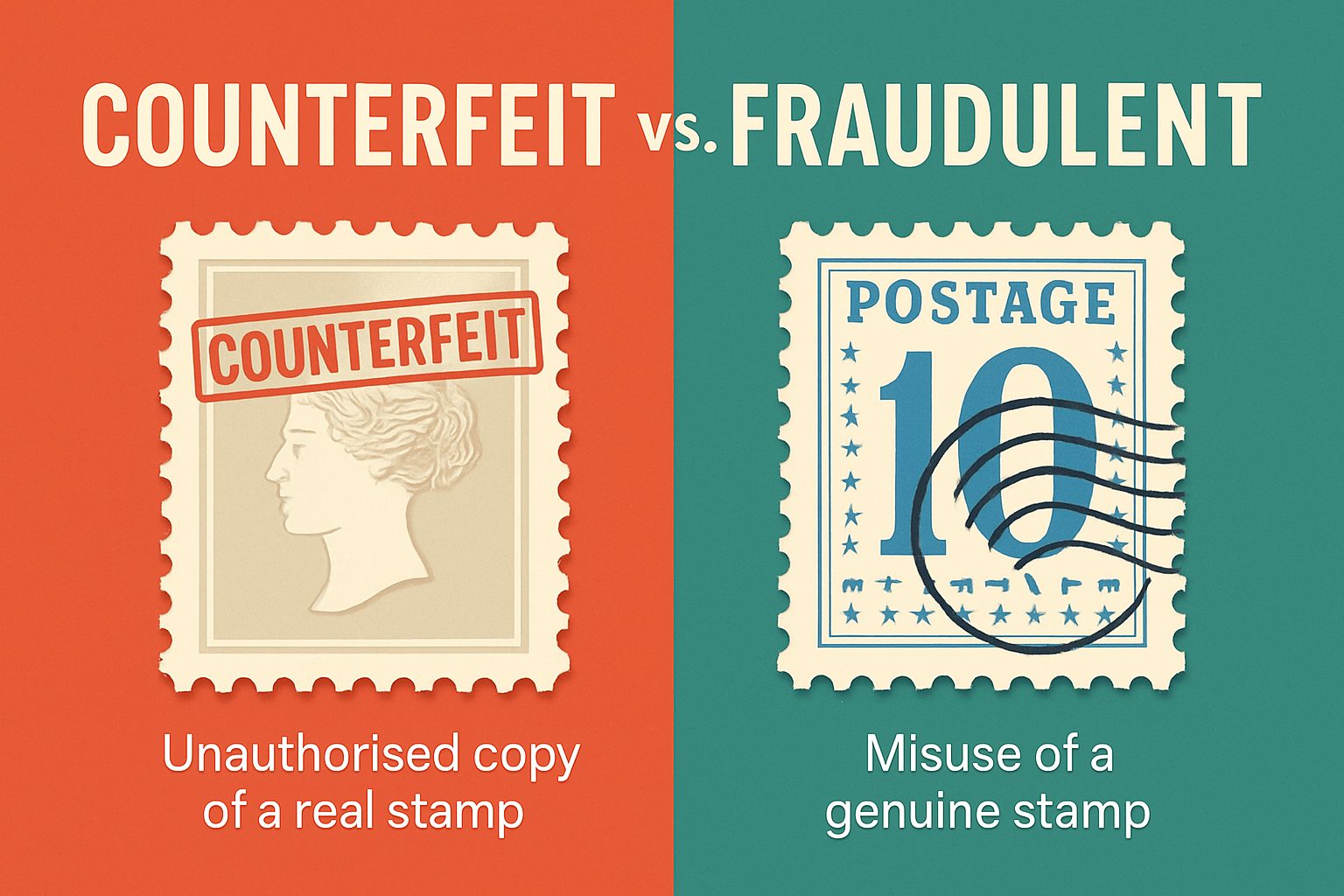
Counterfeit stamps are unauthorised copies made to look like real postage, while fraudulent stamps involve the misuse of genuine ones to dodge postal fees.
In the world of stamp collecting, few things raise eyebrows like the word “fake.” But not all fakes are the same. Understanding the difference between counterfeit and fraudulent stamps can help you spot trouble before it sneaks into your collection. It also opens up an super interesting side of postal history that’s sometimes overlooked.
At first glance, the terms might seem interchangeable. Both involve some form of sneaky deception. Both have caused headaches for postal authorities, and both can occasionally end up in your album. But dig a little deeper and you’ll find they tell very different stories.
What is a counterfeit stamp?
A counterfeit stamp is basically a copycat. It’s an unauthorised reproduction of a real postage stamp. It’s made to look official but never printed or sold by the actual postal service. These were made to cheat the system, often used in bulk to avoid paying real postage, and nowadays, they’re sometimes sold online in shady-looking discount packs.
They might look convincing at a glance, but close up, they often give themselves away. Things like fuzzy printing, odd paper, slightly off colours, or blurry details that don’t quite line up with the genuine article.
While many counterfeit stamps are produced to evade postal fees, a significant number are crafted with the intent to defraud collectors. These forgeries often replicate rare or valuable stamps and are sold as genuine items to unsuspecting buyers. Notable examples include the works of Jean de Sperati and Peter Winter, who produced high-quality forgeries that have fooled even seasoned collectors. Additionally, some modern counterfeit stamps are sold online at discounted prices, targeting both mail users and collectors.
What’s fraudulent stamp then?
Fraudulent stamps are a bit more sly. They’re usually genuine stamps that someone’s tried to reuse or mess with to get out of paying postage. For example, soaking off a cancellation mark to pass it off as unused, or tweaking the value printed on the stamp. Some people even used revenue or charity stamps and hoped no one at the post office would notice.
So unlike counterfeits, these started out as real stamps—they’ve just been tampered with along the way.
A quick look at the key differences
Here’s a handy comparison to break it down at a glance:
| Feature | Counterfeit Stamps | Fraudulent Stamps |
|---|---|---|
| What it is | Unauthorized copies of real stamps | Genuine stamps misused or altered |
| Purpose | Evade postage fees or deceive collectors | Reuse or modify stamps to avoid paying full postage |
| Legality | Illegal to produce, sell, or use | Illegal to use for postage; legality varies by context |
| Common signs | Poor print quality, incorrect paper, blurred details | Signs of erasure, regumming, forged cancellations |
| Collector interest | Some value as curiosities or historical items | Often collected as part of postal history or forgery studies |
Who Would Make Fraudulent Stamps?
Jean de Sperati (1884–1957)
One of the most infamous and skilled stamp forgers of all time.
- What he forged: Sperati specialised in high-value classic European stamps, including rare issues from France, Italy, and the British Empire. His reproductions were so convincing that many were certified as genuine.
- How they were spotted: Experts eventually noticed minute discrepancies in cancellation marks, paper type, and ink composition. Ironically, it was Sperati’s use of high-quality techniques, like photogravure and real stamp paper, that led to closer scrutiny. His forgeries were catalogued in The Sperati Album and are now collectible in their own right.
- Interesting fact: His forgeries are so respected that they often fetch high prices at auction as forgeries.
Peter Winter (b. 1941)
A German artist who created forgeries mainly in the 1980s.
- What he forged: Winter focused on iconic rarities such as the British Guiana 1c magenta, various classic US stamps, and other extremely rare items.
- How they were spotted: Winter used modern printing techniques like offset lithography, which left a different texture and finish compared to the originals. UV light and microscopic inspection often revealed modern materials or pixelation patterns.
- Controversy: Winter sometimes marketed his creations as “reproductions” or “facsimiles,” but these distinctions weren’t always made clear, especially when stamps were resold by third parties.
The Fournier Forgeries (late 19th – early 20th century)
Produced by François Fournier, who saw himself as offering affordable substitutes for collectors.
- What he forged: A massive catalogue of stamps from all over the world—especially rare or hard-to-find issues from smaller countries.
- How they were spotted: His stamps often lacked genuine postal cancellations, and while he created imitations of postmarks, they were frequently generic or poorly matched to real post office usage. He also sold in bulk, raising suspicion.
- Legacy: Fournier’s work is so extensive that many collectors now study it as a field of its own. The Album de Fac-similés was created to help philatelists identify his forgeries.
Some Famous Counterfeit Stamps
Operation Cornflakes (WWII, Germany/Allies)
- What happened: This was a clever Allied propaganda mission during World War II. Fake German stamps were printed with subtle design alterations (like Hitler’s face subtly replaced with a skull).
- Purpose: These were used to mail anti-Nazi propaganda inside Germany via intercepted mail trains.
- How they were spotted: The changes were deliberately subtle, but once uncovered, they became a fascinating example of psychological warfare using counterfeits.
Modern US Postal Counterfeits (Ongoing)
- What’s happening: In recent years, counterfeit Forever Stamps—especially with patriotic themes like the US Flag—have been widely distributed online via shady sellers (often through eBay, Facebook, or direct websites).
- Purpose: These are created to undercut legitimate postage costs and sold in bulk at a discount.
- How they’re spotted: Under magnification or UV light, the print resolution and tagging are often wrong. The perforations can be off, and the gum might have a different texture. The USPS has issued warnings and shut down many operations, but new versions continue to appear.
Counterfeit Chinese Stamps
- What happened: As stamp collecting boomed in China, so did the fakes. Counterfeiters began printing popular commemorative issues, especially those with themes like pandas or revolutionary history.
- Purpose: Mostly to sell to collectors and traders, sometimes passed off as unused stock.
- How they were spotted: Inconsistent print quality, wrong paper, missing security features. Chinese postal authorities cracked down heavily, and today many collectors are very cautious when buying older issues.
There is also more recent news regarding Chinese Counterfeit stamps.
How to Spot a Philatelic Forgery: Quick Tips
| Technique | What to Look For |
|---|---|
| Magnification | Check fine details! lines should be crisp and clear, not fuzzy or pixelated. |
| UV Light | Modern inks and paper can fluoresce under UV, unlike genuine 19th-century stock. |
| Watermark Detection | Compare with known watermark patterns, fakes often get this wrong. |
| Paper & Gum Analysis | Authentic gum and paper feel different and age differently. |
| Expert Certificates | When in doubt, consult an expert or a recognised philatelic authority. |
Counterfeit and fraudulent stamps might look similar on the surface, but they each tell a different story—one about deception in design, the other about misuse in action. For collectors, knowing the difference isn’t just about protecting your collection. It’s about understanding the quirks and curiosities that make stamp collecting so fascinating.
Whether you’re drawn to the detective work of spotting forgeries or simply want to avoid being caught out by a too-good-to-be-true find, a little knowledge goes a long way. And who knows? That suspicious stamp might just turn out to be a fascinating piece of postal history in disguise.
