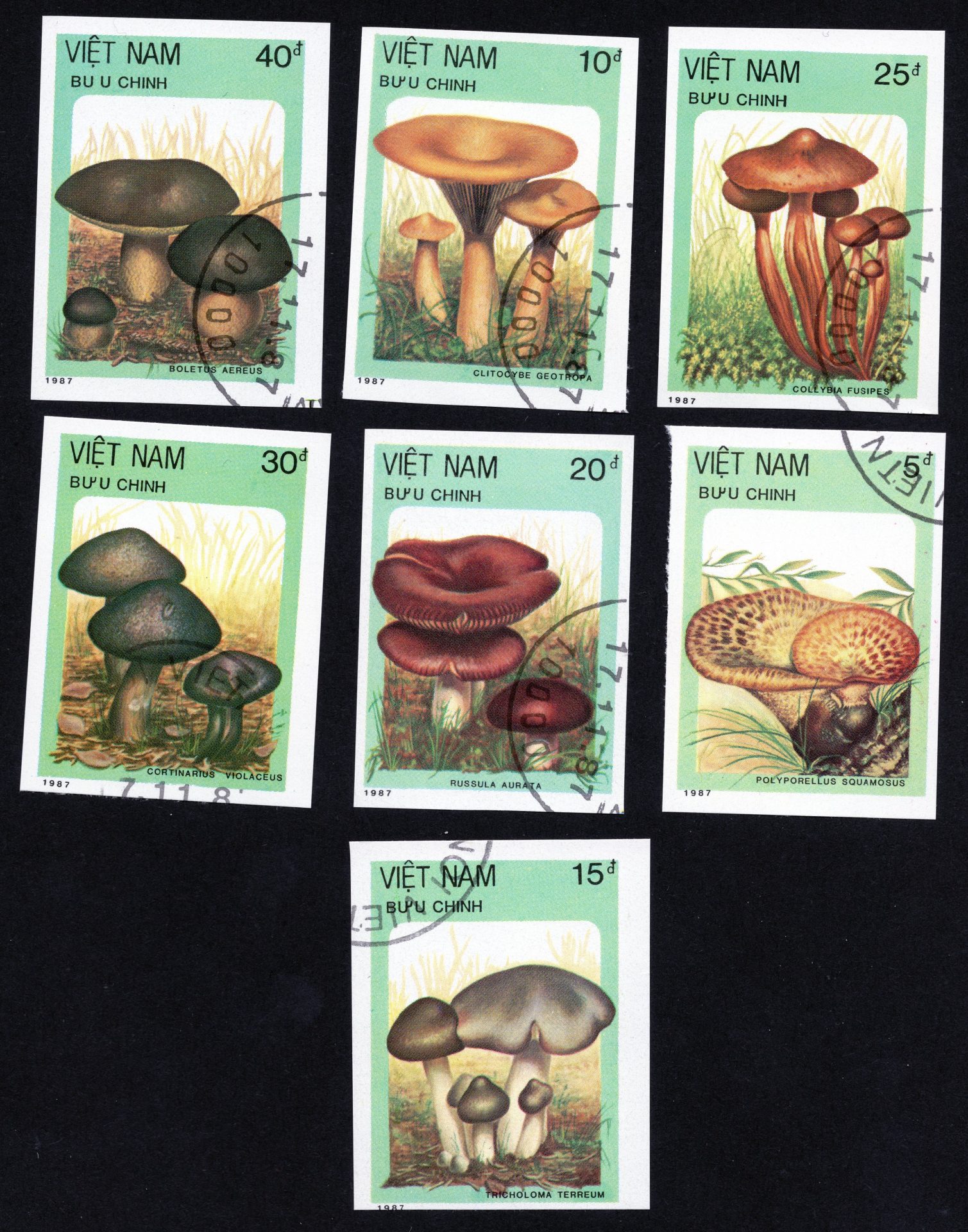
The 1987 mushroom series issued by Vietnam’s postal service is a well-known and attractive set for collectors interested in natural history themes. The set includes seven stamps, each depicting a different species of mushroom with its scientific name printed clearly. The artwork is detailed and accurate, reflecting the illustrative style commonly used in Vietnamese stamps of the period.
The stamps in this issue are:
| Value | Scientific Name | Common Name |
|---|---|---|
| 5₫ | Polyporellus squamosus | Dryad’s Saddle |
| 10₫ | Clitocybe geotropa | Trooping Funnel |
| 15₫ | Tricholoma terreum | Grey Knight |
| 20₫ | Russula aurata | Golden Brittlegill |
| 25₫ | Collybia fusipes | Spindle-shank |
| 30₫ | Cortinarius violaceus | Violet Webcap |
| 40₫ | Boletus aereus | Bronze Bolete |
One of the notable characteristics of this set is that the stamps are imperforate. Unlike perforated stamps, which are separated by small punched holes along the edges to allow for easy tearing, imperforate stamps are printed as full sheets and must be cut apart manually. The edges on these stamps are slightly uneven, which is consistent with hand-cut or mechanically guillotined sheets. Imperforate issues were commonly produced for collectors, often in smaller quantities, and were not typically intended for general postal circulation.
Cancellation Marks
Another key feature of this set is the presence of cancellation marks. These stamps are Cancelled-To-Order (CTO), meaning they were cancelled by the postal authority without being used for actual mail. The cancel shows “HANOI” and the date “17-4-87”, which is likely the official release or first day of issue. CTO stamps are usually neatly cancelled and retain full gum on the back. They were primarily sold in sets to collectors, both domestically and internationally.
The Vietnam 1987 mushroom issue is a good example of a thematic set that combines botanical accuracy with collector appeal. While CTO stamps and imperforate issues are generally less sought after by traditionalists who prefer postally used material, this set remains a popular and affordable choice for those collecting by theme or region. It also provides a useful introduction to different stamp formats and production techniques.
This set is often found in good condition and is suitable for inclusion in topical collections focused on fungi, biodiversity, or Southeast Asian postal issues.
Take a look at my other mushroom stamps, or read more about fungi on stamps if this is something you liked. Here are 3 you might enjoy: Burkina Faso (1985), Togo (1999) and Somali Republic (1985)
Primary Sources and References
- Michel Catalogue (Asia volumes)
Provides detailed listings of Vietnamese stamps, including issue dates, denominations, and themes. The 1987 mushroom series is catalogued here with illustrations and notes on perforation and CTO versions. - Scott Standard Postage Stamp Catalogue
Lists the 1987 mushroom set under Vietnam, confirming the species depicted and their official status. Also includes notes on common availability as CTO. - Colnect (www.colnect.com)
An online stamp catalogue and collector marketplace that lists the 1987 Vietnam mushroom set with images, scientific names, values, and cancel types.
Direct link to the set: Vietnam 1987 Mushrooms – Colnect - Stampworld (www.stampworld.com)
Provides high-resolution images and metadata (e.g. imperforate format, issue type, cancellation style) for Vietnamese stamps, including the 1987 fungi set. - Vietnam Philately Forums and Blogs
Posts and discussions from Vietnamese and international collectors describing CTO practices, first day cancels, and how these sets were marketed during the 1980s. - General Philatelic Resources
- Stanley Gibbons Stamp Monthly articles on collecting Vietnamese stamps
- American Topical Association resources on mushroom-themed stamps
